
Desert home power outage can quickly become more than a temporary inconvenience when your property is sitting vacant in the Coachella Valley. Without someone there to verify that critical systems have restarted correctly, a simple outage can lead to HVAC problems, spoiled food, offline security systems, and other costly issues. If you own a seasonal or second home in Palm Springs, Rancho Mirage, Palm Desert, La Quinta, Indio, Cathedral City, Indian Wells, Desert Hot Springs, or Bermuda Dunes, here’s what you should do when the power goes out while you’re away—and how professional Home Watch services can help protect your investment.
Learn what to do during a desert home power outage and how Home Watch inspections help protect vacant homes throughout the Coachella Valley.
1) The problem: Why a simple outage becomes a bigger issue in a vacant desert home
When the lights go out, the immediate concern is usually comfort. But when no one is home, the bigger risks are the “silent” ones:
• HVAC stops and indoor temperatures climb. Even if your home is set to a higher “away” temperature, no power means no cooling. Prolonged heat can stress electronics, certain finishes, and anything sensitive you’ve stored.
• Your refrigerator/freezer warms up. If the outage lasts long enough, you can end up with spoiled food and odors that linger.
• Security systems and internet may go down. Many alarm panels have battery backup, but Wi‑Fi routers and modems often don’t. If your system relies on internet, you may lose remote visibility.
• Garage door openers and gates may not function. If you need someone to access the property, entry can become complicated.
• Sump pumps, pool equipment, and irrigation timers can reset. Some devices don’t resume normal schedules after an outage.
• Power restoration can create its own problems. When power returns, surges can trip breakers, GFCIs can remain off, and some HVAC systems won’t restart cleanly without a reset.
The core issue isn’t just the outage—it’s the lack of eyes on the home during and after the event.
2) Immediate steps: What to do in the first hour (even if you’re out of state)
If you learn about an outage through a neighbor, an alert, or a smart device going offline, focus on confirming what’s happening and protecting the home from the most common follow-on problems.
Step 1: Confirm whether it’s a neighborhood outage or just your home
• Check your utility provider’s outage map (if available) and see if your street or neighborhood is affected.
• If you have smart devices, note what went offline. If everything dropped at once (thermostat, cameras, Wi‑Fi), it’s more likely a full outage.
• If only one device is offline, it could be a router issue, a tripped breaker, or a device failure.
Step 2: Try to determine if power has returned
• If your thermostat app reconnects and shows current temperature, that’s a good sign.
• If cameras come back online, check for timestamps and whether they rebooted.
Step 3: Contact a local point of contact to physically verify conditions
If you don’t have a trusted neighbor who can check the exterior, this is where a professional home watch service is valuable. A quick on-site verification can answer questions you can’t solve remotely:
• Is the whole neighborhood out, or just your home?
• Are any exterior lights on/off unexpectedly?
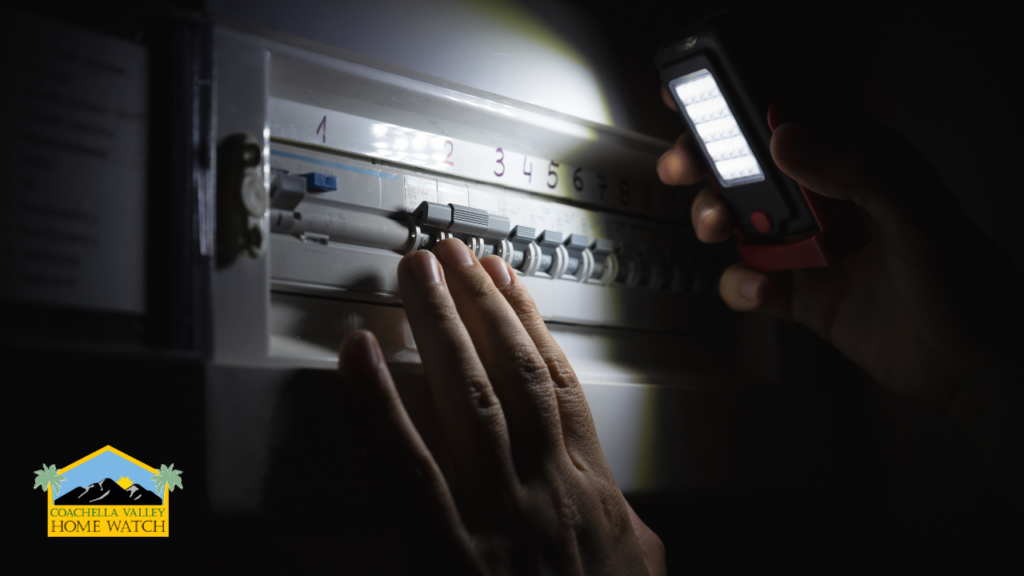
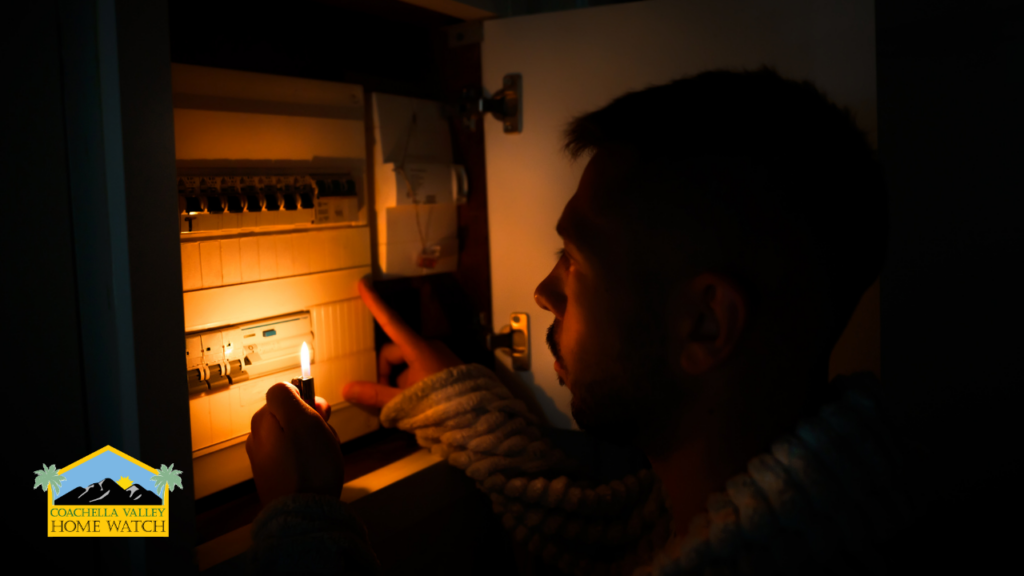
• Are there signs of a tripped breaker (e.g., some circuits dead, others live)?
• Are there any obvious hazards (smell of smoke, buzzing panel, downed lines nearby)?
Step 4: Avoid “guessing” resets from afar
It’s tempting to instruct someone to flip breakers or reset GFCIs immediately. But if there’s an underlying issue (a failed appliance, water intrusion, a short), repeated resets can be unsafe. The safer approach is: verify conditions first, then reset only if it’s appropriate.
Step 5: Document the timeline
Write down:
• When you first noticed the outage
• Any alerts you received
• When devices went offline/online
• Who checked the property and what they observed
This helps if you need to coordinate repairs, file an insurance claim, or track recurring issues.
3) Preventive setup: Reduce risk before you leave the Coachella Valley
The best time to deal with a desert home power outage is before it happens. A few targeted steps can dramatically reduce damage potential.
A) Set your HVAC up for “safe failure”
• Use an “away” setpoint that protects the home without overworking the system.
• Replace filters before you leave so the system runs efficiently when it’s on.
• Consider a thermostat that sends alerts for temperature thresholds (high/low) and loss of connectivity.
B) Add surge protection where it matters
When power returns, surges can be hard on electronics and HVAC boards.
• Whole-home surge protection (installed by a licensed electrician) can help.
• At minimum, use quality surge protectors for sensitive equipment.
C) Plan for refrigerator/freezer risk
If you leave food in the home:
• Keep the freezer full (frozen water bottles help maintain temperature longer).
• Consider clearing perishables before long absences.
• Use a simple temperature sensor in the fridge/freezer if you want alerts.
D) Make sure someone can access the property
• Provide a reliable key/lockbox plan.
• Ensure gates and garage access are workable during outages.
• Keep vendor contact info organized (electrician, HVAC, plumber, pool service).
E) Know what “normal” looks like
A home watch routine that establishes a baseline—thermostat readings, typical humidity, normal breaker/GFCI status, and visual condition—makes it easier to spot what changed after an outage.
4) After power returns: What must be checked on-site (and why)
Even if power is restored quickly, it’s smart to verify that critical systems actually resumed normal operation. Many homeowners assume “power is back” equals “everything is fine.” In vacant homes, that assumption is where problems hide.
Here are the key checks that matter most:
A) HVAC operation and thermostat status
• Confirm the thermostat is online and calling for cooling when appropriate.
• Confirm the system is actually running (not just the thermostat display).
• Listen for unusual noises if someone is on-site.
• Check that condensate lines aren’t leaking and that the area around the air handler is dry.
Why it matters: If the HVAC didn’t restart, indoor temperatures can climb for days before anyone notices.
B) Electrical panel, breakers, and GFCIs
• Look for any tripped breakers.
• Check common GFCI locations (kitchen, bathrooms, garage, exterior outlets).
Why it matters: A single tripped GFCI can disable a garage fridge, exterior lighting, or outlets that power security equipment.
C) Refrigerator/freezer condition
• Check internal temperature (or at least whether items are still frozen).
• Look for leakage, odors, or condensation.
Why it matters: Spoiled food and odor remediation can be far more expensive than the food itself.
D) Security system, cameras, and internet
• Confirm router/modem are online.
• Confirm cameras are recording.
• Confirm alarm panel status and that it’s communicating.
Why it matters: If your monitoring went down during the outage and never came back, you may be “blind” without realizing it.
E) Water-related checks
• Look for signs of leaks under sinks, at water heater areas, and around toilets.
• If you have a water shutoff device, confirm it’s functioning and not in an error state.
Why it matters: Some leaks are discovered only after power restoration (for example, if a recirculation pump or appliance restarts).
F) Pool/spa equipment and timers
• Confirm pumps and timers are running on the intended schedule.
• Check for error codes.
Why it matters: In the desert, a pool system that stays off can lead to water quality issues quickly.
5) How a home watch visit helps during a desert home power outage
For seasonal and absentee owners, the biggest challenge is speed and certainty. You don’t just need someone to “take a look.” You need a consistent, documented process that confirms the home is safe and operating normally.
Coachella Valley Home Watch supports second-home owners across the Coachella Valley with on-site checks that are especially valuable during and after their desert home power outage:
• Rapid verification: Confirm whether it’s a utility outage or a home-specific electrical issue.
• System checks: HVAC status, thermostat connectivity, breakers/GFCIs, refrigerator/freezer condition, and visible water issues.
• Documentation: Notes and photos so you can make decisions confidently from wherever you are.
• Coordination: If a licensed electrician, HVAC technician, or other vendor is needed, we can help coordinate access and follow-up so you’re not trying to manage it remotely.
A desert home power outage doesn’t have to become a costly surprise. With the right preparation and a clear response plan, you can protect your property, reduce downtime, and avoid the most common “after the outage” problems that catch absentee owners off guard.
If you’d like help building a simple outage-response checklist tailored to your home—or you want consistent home watch visits so issues are caught early—Coachella Valley Home Watch can help.